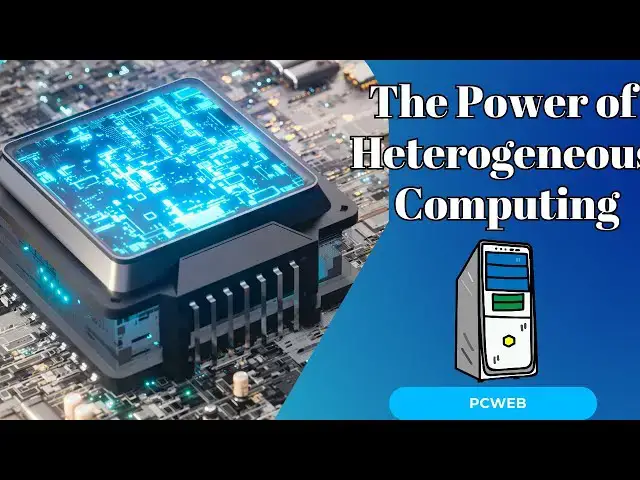

The Power of Heterogeneous:Computing Revolutionizing Electronic Devices
Aug 19, 2024
The Power of Heterogeneous Computing: Revolutionizing Electronic Devices
Imagine a world where your electronic devices run faster, more efficiently, and handle complex tasks with ease. This is not a distant dream but a reality made possible through heterogeneous computing.
Heterogeneous computing refers to the integration of various types of processors within a single system to enhance performance and energy efficiency. By combining general-purpose processors (CPUs) with specialized processors like graphics processing units (GPUs) and field-programmable gate arrays (FPGAs), this approach maximizes the strengths of each processor type to tackle diverse computational tasks.
At its core, heterogeneous computing addresses the limitations of homogeneous systems, which rely solely on CPUs. While CPUs excel in executing a wide range of tasks, they often fall short in processing specialized functions such as rendering graphics or performing complex mathematical computations. By leveraging the unique capabilities of GPUs, which are designed to handle parallel processing, and FPGAs, which offer customizable hardware solutions, heterogeneous computing ensures that each task is executed by the most suitable processor.
The benefits of heterogeneous computing are manifold. First and foremost, it significantly boosts performance. By distributing workloads across multiple types of processors, tasks are completed faster and more efficiently. This is particularly advantageous in areas such as gaming, where high-resolution graphics and real-time rendering are paramount, and in scientific research, where complex simulations and data analysis demand immense computational power.
Energy efficiency is another critical advantage. Traditional computing systems can be power-hungry, leading to increased operational costs and environmental impact. Heterogeneous computing, however, optimizes power usage by assigning tasks to processors that consume less energy for specific functions. This not only reduces energy consumption but also extends the battery life of portable devices, making it an appealing choice for laptops, smartphones, and tablets.
Moreover, heterogeneous computing paves the way for innovative applications in artificial intelligence (AI) and machine learning (ML). These fields require substantial computational resources to process large datasets and execute sophisticated algorithms. By harnessing the power of GPUs and FPGAs, heterogeneous systems can accelerate AI and ML tasks, enabling faster model training and more accurate predictions.
For electronics enthusiasts and professionals alike, the transition to heterogeneous computing represents a significant leap forward. It opens up new possibilities for designing high-performance, energy-efficient devices capable of handling the most demanding applications. As we continue to push the boundaries of what our electronic devices can do, embracing heterogeneous computing will be crucial in meeting future challenges and demands.
Are you ready to explore the transformative potential of heterogeneous computing in your electronic devices? Share your thoughts and join the conversation below.
See more:
The Future at Your Fingertips:The Power and Potential of Mobile Computing
https://youtu.be/E6jDveNbxOE
Hashtags: #HeterogeneousComputing #ElectronicsInnovation #FutureOfDevices
Show More Show Less #Computers & Electronics
#Computer Hardware
#Computer Hardware
#Desktop Computers
#Laptops & Notebooks
#Consumer Electronics
#Electronics & Electrical
#Engineering & Technology
#Hardware Modding & Tuning